


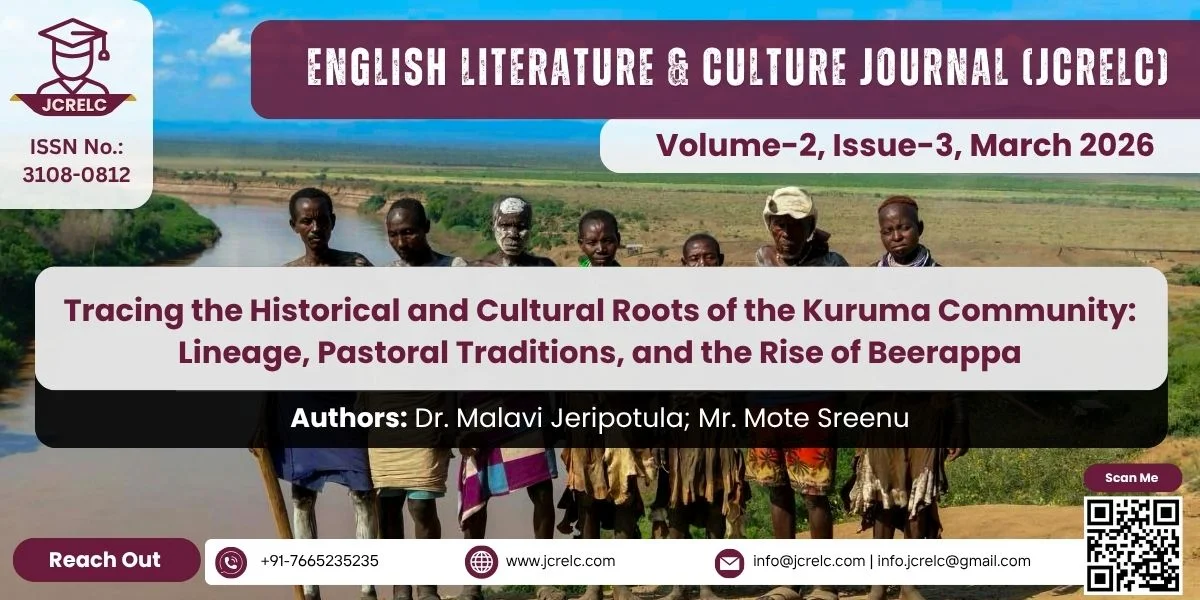
Tracing the Historical and Cultural Roots of the Kuruma Community: Lineage, Pastoral Traditions, and the Rise of Beerappa
Abstract
Telangana state has formed on the grounds of culture, heritage and exclusive festivals. It is one of those states that has multi-communities and diverse cultures. One of the many communities is the Kuruma community. Not much research has been done on this community in mainstream literature. Indeed, their culture and heritage are noteworthy to study. This research article delves into the history of the Kuruma community, and how Beerappa has become the patron deity of the community. It also examines whether the characters involved in the story of Beerappa are fictional or real. In addition, this research article focuses on why the Kuruma religion is called the Religion of Milk, and the different types within the Kuruma community. The inscriptions laid by the great kings which are related to this community are also examined. All in all, this article studies the objects that are relevant to this community through a historical approach rather than a cultural approach. While the Rajputs had Col. Tod, the Marathas had Grant-Duff, the Sikhs had Cunningham, and even the Jats had K. R. Kanungo, the Kurumas and Golla had none. The All India Yadava Mahasabha approached Rajbali Pandey to write the history of these two communities, but he miserably failed them. This research paper will try to find out the historical evidences of the Kuruma community.
Keywords
Download Options
Introduction
The Kuruma community is one of the oldest rural communities in the states of Telangana and nearby regions like Karnataka. For generations, they have lived by rearing sheep and goats (as they are often called the Shepherd community), which has shaped not only their economy (sheep-economy) but also their way of life, beliefs, and traditions. This community's history is mostly carried forward through oral stories, ballads, folk songs, and rituals, because very little is written about them in mainstream history. Because of this, many aspects of their culture and heritage remain less studied.
There are many traditions associated with this community. Among them, the worship of Beerappa holds a special place. Beerappa is seen as the lord protector of their flocks and the guide of their community. Over time, he has grown from being a local folk god into the Patron Deity of the Kurumas. His story is closely tied to their occupation and daily struggles, and through him the Kurumas express their identity, unity, and cultural pride. Rituals like Oggu Katha performances, community festivals, and ceremonies such as Beerappa-Kamarathi Kalyanam show how strongly his worship is woven into their lives. All these are told in the form of ballads, stories and oral folk songs.
Conclusion
The Kuruma community has a long and rich history that has been preserved mainly through oral stories, folk songs, and rituals rather than written records. Their way of life, centered around shepherding and animal care, has shaped their culture, beliefs, and social practices over centuries. Beerappa, who was first a heroic human and later became a god, represents the courage, wisdom, and values of the Kuruma people. He protects their flocks, guides the community in moral and ethical living, and serves as a symbol of their unity and identity.
The story of Beerappa also reflects how law and social order exist in societies even without formal courts, police, or written rules. The Kurumas follow strict customs and taboos not just as religious practices, but because these rules are essential for the safety of their animals, the well-being of the community, and the continuity of their traditions. Rituals, moral teachings, and social punishments, like exclusion from ceremonies, help reinforce these unwritten rules. This shows how deeply religion, daily life, and social order are connected in non-state communities.
Historically, the Kurumas/Kurubas have played an important role in protecting their lands, resisting outside influences, and preserving their culture. Traditions like the Veeragallu hero-stones, the worship of Beerappa, and the Halu Mata religion highlight the bravery, generosity, and spiritual devotion of this community. Their close connection with pastoral life also links them to some of the earliest civilizations, showing that shepherding and animal care were central to human development.
Beerappa is more than just a deity; he is a living symbol of the Kuruma community's history, culture, and values. Studying his story helps us understand how the Kurumas maintain their identity, social order, and traditions through myths, rituals, and everyday practices. This research highlights the importance of historical evidence, oral traditions, and ethnological study in understanding the roots and heritage of the Kuruma people, ensuring that their rich culture is recognized and remembered for future generations.

References
[1] Nagasheshu, B. (2024). Beerappa: A historical & cultural hero. Kasturi Vijayam Press.
[2] Vasudev, R. (2011). Oggu Katha-accompanied imitations and expressions. Dravidian University Press.
[3] Nagasheshu, B. (2023). Ekudaram: Chethivruthula santhakam. Kasturi Vijayam Press.
[4] Yadav, J. N. S. (1992). Yadavas through the ages: From ancient period to date (Vol. 1). Sharada Publishing House.
[5] Yadav, J. N. S. (1992). Yadavas through the ages: From ancient period to date (Vol. 2). Sharada Publishing House.
[6] Nagasheshu, R. (2023). History and culture of Kuruma/Kuruba community. Palamuru University Press.
[7] Thurston, E. (1901). Castes and tribes of Southern India (Vol. 2). Government Press.
[8] Sreenu, M., & Malleh, B. (2022). The hidden legend of folk art… The deity of Oggu Katha… The power of determination and the symbol of women empowerment – Jamma Mallari. International Journal of Research and Analytical Reviews, 9(4), 501– 505. https://ijrar.org/papers/IJRAR22A1445.pdf
[9] Pavani, C. (2025). Birappa narrative: An anthropological reading of pastoral law in the Kuruma of Telangana. International Journal of Humanities and Social Science Research, 11(2), 85–88. https://www.socialsciencejournal.in/assets/archives/2025/vol11issue2/11096.pdf
[10] Murthy, M. L. K. (1991/1992). Beerappa and Mallanna: The emergence of folk gods in the religion of Kuruvas and Gollas of Andhra Pradesh. *Bulletin of the Deccan College Post-Graduate and Research Institute, 51/52*, 563–572. https://www.jstor.org/stable/42930441
[11] Hindu Post. (2025, September 30). Know about the Kula Daivam Beerappa, an incarnation of Sri Veerabhadra. Hindu Post. https://hindupost.in/dharma-religion/know-about-the-kula-daivam-beerappa-an-incarnation-of-sri-veerabhadra/
[12] Chatterjee, S. K. (2010). Studies on the Dravidian culture. Heritage Press.
[13] Durant, W. (1950). The story of civilization. Simon & Schuster.
[14] Hegde, O. (2008). Sources of Vijayanagara. Karnataka University Press.
[15] Iyengar, S. K. (1995). The sources of Vijayanagara. University Press.
[16] Muller, M. (1885). The popular educator. Oxford University Press.