


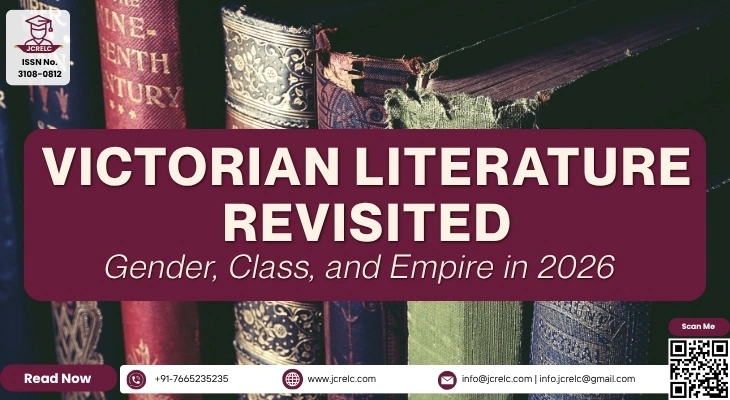
Victorian literature, produced during the reign of Queen Victoria (1837–1901), remains one of the most influential periods in English literary history. Writers such as Charles Dickens, the Brontë sisters, Thomas Hardy, and George Eliot explored rapid industrialization, shifting social hierarchies, gender constraints, and the expansion of the British Empire.
In 2026, Victorian literature is being revisited through new critical frameworks that emphasize gender studies, postcolonial theory, digital humanities, and class analysis. These approaches reveal how deeply Victorian texts are connected to modern concerns about inequality, identity, and global power structures. For researchers exploring these interdisciplinary connections, learning how to write a research paper for a Scopus journal is essential for publishing impactful work in this field.
Victorian Literature in Modern Scholarship
Modern literary studies no longer treat Victorian literature as purely historical. Instead, it is viewed as a living archive of social, political, and cultural transformation. This connects with broader discussions in Cultural Studies vs Cultural Research, where historical texts are analyzed through contemporary critical frameworks.
Key areas of focus include:
- Industrial capitalism and labor exploitation
- Gender roles and domestic ideology
- Colonial expansion and imperial discourse
- Urbanization and social inequality
- Moral and religious debates
Victorian texts are increasingly read as reflections of early modern globalization.
Gender and Victorian Literature
Gender studies has significantly reshaped interpretations of Victorian fiction and poetry. This aligns with discussions in Feminist Literary Criticism 2026 and Queer Theory and Literature.
Key themes include:
- The "separate spheres" ideology of men and women
- Restrictions on female education and autonomy
- Marriage as economic and social institution
- Female authorship and literary resistance
- Representation of women's desire and identity
Writers like the Brontë sisters and George Eliot challenged dominant gender expectations through complex female characters.

Class Structures and Social Inequality
Victorian literature is deeply concerned with class division, especially in the context of industrial capitalism.
Common representations include:
- Wealth inequality between industrial elites and workers
- Urban poverty and child labor
- Social mobility and its limitations
- The rise of the middle class
- Moral judgments tied to class status
Charles Dickens, in particular, exposed the harsh realities of industrial society.
Empire and Postcolonial Readings
In 2026, Victorian literature is increasingly examined through postcolonial perspectives. This connects with discussions in Postcolonial Literature 2026, where colonial histories and resistance narratives are central themes.
This includes:
- Representation of colonial subjects in literature
- Justification of imperial expansion through narrative
- Exoticism and "Othering" in Victorian fiction
- Economic exploitation of colonized regions
- Resistance narratives within imperial contexts
These readings reveal how literature supported and questioned imperial ideology.
Industrialization and Urban Experience
The Victorian era witnessed rapid industrial growth, which shaped literary themes.
Literature reflects:
- Factory labor and mechanization
- Urban overcrowding and pollution
- Changing landscapes and rural displacement
- Technological progress and anxiety
- Social reform movements
Cities like London became central symbolic spaces in Victorian fiction.
Victorian Women Writers and Literary Authority
Women writers played a crucial role in shaping Victorian literature.
Key contributions include:
- Challenging male-dominated literary traditions
- Exploring domestic life and emotional depth
- Addressing social reform and education
- Publishing under pseudonyms due to gender bias
Authors like Elizabeth Gaskell and George Eliot expanded the literary canon.
Digital Humanities and Victorian Texts
In 2026, digital tools are transforming how Victorian literature is studied. For more on how AI and computational tools are reshaping literary analysis, see Digital Humanities in Literary Studies.
Scholars use:
- Text mining to analyze large corpora of Victorian novels
- Digital archives of newspapers and serial publications
- Visualization of social networks in fiction
- AI-assisted thematic mapping
These methods uncover patterns previously hidden in traditional reading.
Victorian Literature in Popular Culture
Victorian literature continues to influence modern media.
Adaptations include:
- Film and television reinterpretations of Dickens and Austen
- Modern retellings of gothic Victorian fiction
- Graphic novels and illustrated adaptations
- Streaming series inspired by Victorian settings
These adaptations keep Victorian themes alive for new audiences. For more on adaptation theory, explore Film Adaptation Theory.
The Gothic Tradition and Psychological Depth
Victorian literature is closely linked to Gothic fiction, which explores psychological and supernatural themes.
Common elements include:
- Haunted spaces and mysterious settings
- Doubles and fragmented identity
- Fear of social and moral collapse
- Repressed desire and hidden truths
Writers like Robert Louis Stevenson expanded the psychological dimensions of Gothic storytelling.
Victorian Morality and Social Critique
Victorian literature often reflects strict moral codes while simultaneously questioning them.
Key tensions include:
- Respectability versus hidden vice
- Religious morality versus social hypocrisy
- Duty versus personal desire
- Public image versus private reality
This moral complexity continues to attract modern readers.
Global Victorian Studies
Victorian literature is now studied as part of global literary networks. This connects with discussions in Comparative Literature Today and Translation Studies Today.
This includes:
- Colonial and postcolonial reinterpretations
- Translation of Victorian texts worldwide
- Comparative studies across empires
- Influence on global realist fiction
Victorian literature is no longer seen as purely British but globally interconnected.
Challenges in Victorian Literary Studies
Despite its richness, Victorian studies face challenges:
- Over-reliance on canonical authors
- Limited representation of marginalized voices
- Difficulty balancing historical context with modern theory
- Risk of ideological over-interpretation
Scholars continue to expand the field to address these gaps.
Future of Victorian Literary Studies
The future of Victorian literature in academia includes:
- AI-enhanced textual analysis
- Interactive digital Victorian archives
- Greater focus on working-class and colonial narratives
- Cross-disciplinary research with history and sociology
- Immersive digital reconstructions of Victorian society
These innovations will continue to reshape understanding of the Victorian era. For additional guidance on academic writing and research, explore AD Publications' guide on writing a complete research paper.
Continue Exploring Our Blog
We invite you to read more insightful articles from our blog to support your academic journey in English Literature, Cultural Studies, and Research Methodology:
-
Medieval Literature in Modern Contexts: Chaucer and Contemporary Relevance
Explore how feminist readings, digital humanities, and postcolonial criticism are reshaping interpretations of Chaucer's works. -
Food Studies and Literature: Reading Culture Through Culinary Narratives
Discover how food represents identity, migration, memory, power, and gender in literary texts across cultures. -
Disability Studies in Literature: Representation and Narrative Voice
Explore how authentic disabled voices, neurodiversity, and intersectionality are reshaping literary representation. -
How Geoffrey Chaucer Influenced Modern English
Understand the linguistic legacy of Chaucer and how his work shaped the evolution of English literature.