


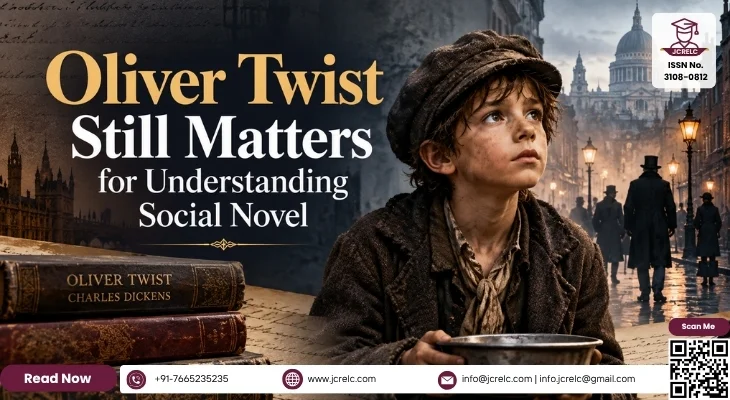
Why do readers still return to Oliver Twist nearly two centuries after its publication?
Charles Dickens's famous novel is often remembered for its memorable characters, dramatic plot, and the famous image of an orphan asking for more food. Yet Oliver Twist is much more than a story about an unfortunate child. It is also an important example of the social novel, a form of fiction that uses storytelling to examine social problems and encourage readers to think critically about the society in which they live.
First published in serial form between 1837 and 1839, Oliver Twist takes readers into the harsh realities of poverty, child exploitation, workhouses, crime, and institutional neglect in Victorian England. Dickens combines entertainment with social criticism, making readers emotionally engage with problems that might otherwise seem distant or abstract. For a broader understanding of how Victorian literature engages with social issues, explore our guide on Victorian Literature Revisited: Gender, Class, and Empire in 2026.
That combination explains why Oliver Twist still matters when we study the social novel today.
What Is a Social Novel?
Before examining Oliver Twist, it is useful to understand what the term social novel means.
A social novel is a work of fiction that focuses significantly on social conditions, inequalities, institutions, or conflicts within a particular society. Rather than presenting characters and events only as personal experiences, the social novel connects individual lives to larger social structures.
Such novels may explore subjects including:
- Poverty and inequality
- Class divisions
- Working conditions
- Education
- Gender inequality
- Child exploitation
- Crime
- Political institutions
- Public health
- Social prejudice
The purpose is not necessarily to provide a complete political solution. Instead, the novel can make social problems visible by showing how they affect individual human beings. This is one of the reasons Dickens's work is so significant.
Oliver Twist as a Social Novel
At the centre of Oliver Twist is an orphan who grows up in an environment where poverty is treated less as a social responsibility and more as a personal failure.
Oliver's experiences expose several problems within Victorian society. He encounters the workhouse system, harsh treatment of poor children, exploitation, and criminal networks. His journey is therefore not simply an adventure. It becomes a way for Dickens to examine how institutions and social attitudes affect vulnerable people.
Oliver himself has very little power.
He is a child without parents, wealth, or social influence. This makes him an effective figure through whom Dickens can explore the experiences of people who have little control over the circumstances into which they are born.
The reader sees society from the perspective of someone who is dependent upon it.

The Workhouse and the Treatment of the Poor
One of the most important social issues in Oliver Twist is the treatment of the poor.
The novel was published shortly after the Poor Law Amendment Act of 1834, which reorganized poor relief in England and placed greater emphasis on workhouses. Dickens's fictional representation of the workhouse became one of the most memorable literary criticisms of the treatment of impoverished people.
Oliver's early experiences demonstrate the cruelty and indifference that can develop when an institution treats poverty primarily as something to control rather than a human condition requiring compassion.
The famous request for more food is significant for precisely this reason.
Oliver's hunger is not merely a personal problem. It symbolizes a larger institutional failure.
The child asks for something as basic as food, yet the response is outrage rather than understanding.
Through this episode, Dickens transforms an economic and political issue into an emotionally powerful human experience.
Childhood as a Tool of Social Criticism
Children occupy a special position in the social novel because they can make social injustice especially visible.
An adult character living in poverty might be blamed by society for poor choices or circumstances. A child is more difficult to dismiss in the same way.
Oliver does not create the conditions in which he lives.
He is born into poverty, becomes an orphan, and is placed under institutional authority. His vulnerability allows Dickens to ask an uncomfortable question: What does a society owe to its children?
This question gives Oliver Twist continuing relevance.
Although modern societies differ considerably from Victorian England, issues involving child poverty, neglect, exploitation, education, and access to basic necessities remain subjects of public concern.
Dickens therefore encourages readers to see children not simply as individuals but as indicators of how a society treats its most vulnerable members.
Poverty Is More Than an Individual Problem
One of Dickens's important contributions to the social novel is his refusal to portray poverty entirely as a consequence of individual moral failure.
The world of Oliver Twist contains characters who are poor, exploited, criminalized, or socially excluded.
Some characters make destructive choices, but Dickens also shows the environment surrounding those choices.
This distinction matters.
If poverty is viewed only as an individual's failure, there is little reason for society to change. But if poverty is connected to institutions, economic conditions, class structures, and social attitudes, then the problem becomes a collective one.
The social novel works precisely through this shift in perspective.
It encourages readers to move from: "What is wrong with this person?" toward: "What is happening within the society that has produced this situation?"
Oliver Twist repeatedly encourages this second question.
Class and Social Division
Class is another central concern of the novel.
Victorian England was marked by significant differences between social groups, and Dickens presents a world in which wealth and social position influence how people are treated.
Oliver's vulnerability is partly the result of his lack of social power.
The novel contrasts people living in poverty with those who possess wealth, authority, or influence. These contrasts help readers understand that social inequality is not simply a difference in income. It can also affect dignity, opportunity, safety, and access to justice.
The social novel therefore uses individual characters to reveal the structures separating different parts of society. For a deeper exploration of class and social structures in Victorian fiction, see our article on Victorian Literature Revisited.
Fagin and the Question of Criminality
Fagin is one of the most recognizable characters in Oliver Twist, but his role is more complicated than simply being a villain.
Through Fagin's criminal network, Dickens explores the relationship between poverty, exploitation, and crime.
Young people who lack stable homes or economic opportunities can become vulnerable to manipulation. The novel demonstrates how criminal environments can exploit children rather than simply depicting young criminals as naturally immoral.
This does not mean Dickens excuses criminal behaviour.
Instead, he asks readers to consider the circumstances that make vulnerable people susceptible to exploitation.
That is another characteristic of the social novel: it looks beyond individual actions to the social conditions surrounding them.
London as More Than a Setting
London is almost a character in Oliver Twist.
The city contains enormous contrasts.
There is wealth alongside poverty, respectable neighbourhoods alongside dangerous streets, and institutions that claim to protect people alongside environments in which vulnerable individuals can be exploited.
Dickens uses these contrasts to create a social map of Victorian London.
The physical movement of Oliver through different parts of the city also represents movement between different social worlds.
The city therefore does not simply provide the background for the story.
It helps communicate the novel's argument.
Dickens and Social Reform
It is important to be careful when discussing Dickens as a social reformer.
His novels clearly draw attention to social problems, but literature does not automatically produce legislative change. Nor does Oliver Twist offer a systematic political programme for eliminating poverty.
Its power lies elsewhere.
Dickens makes social problems emotionally visible.
Statistics can communicate the scale of poverty. Reports can describe institutional conditions. Political speeches can argue for reform.
A novel can do something different.
It can make readers imagine what it feels like to be hungry, powerless, frightened, exploited, or ignored.
That emotional dimension is one of the great strengths of the social novel.
Sympathy as a Literary Strategy
One of Dickens's most effective techniques is the creation of sympathy.
Readers are encouraged to care about Oliver as an individual.
Once readers become emotionally invested in him, the social conditions surrounding him become harder to ignore.
This is important because social problems can easily become abstract.
"Child poverty" is a broad concept.
"An orphaned child who is hungry and powerless" is a human story.
By turning an abstract social issue into an individual experience, Dickens gives social criticism emotional force. This technique connects with broader discussions in Cognitive Literary Studies, where empathy and reader response are central concerns.
Sentiment and Social Criticism
Some modern readers may find Dickens's sentimental style excessive.
His use of emotional scenes, dramatic contrasts, exaggerated characters, and moral divisions can sometimes appear less subtle than contemporary literary approaches.
However, these features should not simply be dismissed.
Sentiment was part of Dickens's strategy.
He wanted readers to feel outrage, sympathy, fear, amusement, and compassion. These emotional responses help turn social criticism into an engaging reading experience.
The social novel does not need to sound like an academic report.
Its power can come precisely from combining serious social questions with compelling storytelling.
The Importance of Institutions
Another reason Oliver Twist remains important is its attention to institutions.
The novel asks what happens when systems designed to manage social problems become detached from the people they are supposed to serve.
The workhouse is particularly important in this respect.
Rather than presenting poverty relief as a simple act of kindness, Dickens shows how institutional rules can create suffering when human needs are subordinated to bureaucracy, discipline, or financial concerns.
This theme extends beyond the nineteenth century.
Modern readers can still recognize debates about whether social institutions genuinely serve vulnerable populations or unintentionally create additional barriers.
Why the Novel Still Matters Today
The world described in Oliver Twist is not identical to the modern world.
Modern societies have different institutions, technologies, laws, and social structures.
Yet several questions raised by Dickens remain relevant:
- How should society respond to poverty?
- What responsibilities do governments and institutions have toward vulnerable people?
- How can children be protected from exploitation?
- What happens when economic inequality becomes extreme?
- Can poverty contribute to vulnerability and criminal exploitation?
- How should society balance punishment with social responsibility?
- What does a humane welfare system look like?
These questions help explain why Oliver Twist continues to appear in discussions of literature and society.
Its historical setting may be Victorian, but its central ethical questions are much broader.
The Social Novel and the Power of Fiction
One of the most valuable lessons of Oliver Twist is that fiction can participate in social discussion.
A novel does not have to be a political document to have political or social significance.
Through characters, settings, conflicts, and emotions, fiction can encourage readers to question assumptions about society.
The social novel works by connecting the private and the public.
Oliver's hunger is personal. The workhouse system is institutional. His vulnerability is individual. The social conditions surrounding that vulnerability are collective.
By connecting these levels, Dickens demonstrates how personal suffering can reveal larger social problems. This aligns with discussions in Cultural Studies vs Cultural Research, where the relationship between individual experience and social structure is a central concern.
What Students Can Learn From Oliver Twist
For students of English literature, Oliver Twist provides an especially useful introduction to the social novel.
It demonstrates how literary techniques can support social criticism.
Characterization: Oliver's vulnerability creates sympathy and focuses attention on the experiences of disadvantaged children.
Setting: Victorian London provides a physical representation of social inequality.
Contrast: Dickens places different social environments and characters beside one another to expose inequality.
Satire: Institutions and socially powerful characters are sometimes presented in exaggerated ways to reveal hypocrisy and cruelty.
Narrative: Oliver's movement through different environments allows readers to encounter different parts of society.
Emotion: Sentimental scenes encourage readers to respond emotionally to social injustice.
Together, these techniques show that social criticism does not have to exist separately from literary artistry.
The Limits of Dickens's Social Vision
A balanced reading should also recognize the limitations of Oliver Twist.
Dickens's representation of poverty is shaped by his own historical period and personal perspectives. His moral categories can sometimes be simplified, dividing characters into relatively clear groups of good and evil.
The novel also contains representations of ethnicity and identity that modern readers may find deeply problematic, particularly in the portrayal of Fagin and the use of antisemitic stereotypes.
These issues should not be ignored.
Instead, they provide another reason to study the novel critically.
A social novel can challenge certain prejudices while reproducing others. Reading Oliver Twist today therefore requires historical awareness as well as appreciation of Dickens's social criticism. This critical approach connects with discussions in Postcolonial Literature 2026, where representation and historical context are central concerns.
Why Oliver Twist Remains Important for Understanding the Social Novel
Ultimately, Oliver Twist matters because it demonstrates what the social novel can accomplish.
It takes large social issues—poverty, class, institutional power, childhood vulnerability, crime, and inequality—and gives them human faces.
It shows that social conditions are experienced by individuals.
It demonstrates how a city can reflect its class structure.
It illustrates how institutions can influence personal lives.
And it reminds readers that literature can encourage questions that extend beyond the fictional world.
The novel's continuing importance does not depend on believing that Victorian London and the modern world are the same.
Instead, its value comes from recognizing that societies continue to struggle with questions about inequality, vulnerability, institutional responsibility, and human dignity.
Oliver Twist still matters because it remains one of the clearest examples of how fiction can transform social problems into human stories.
Through Oliver's experiences, Dickens examines poverty, childhood, class, crime, institutional authority, and social responsibility. His approach demonstrates the central power of the social novel: to make readers see society through the lives of individuals.
The novel is not a perfect representation of social reality, and modern readers should approach its stereotypes and assumptions critically. Yet that complexity makes it even more valuable for literary study.
To understand the social novel is to understand how literature can connect private suffering with public issues.
And Oliver Twist continues to demonstrate that connection. For additional guidance on academic writing and research, explore AD Publications' guide on writing a research paper for a Scopus journal.
Continue Exploring Our Blog
We invite you to read more insightful articles from our blog to support your academic journey in English Literature, Cultural Studies, and Research Methodology:
-
Victorian Literature Revisited: Gender, Class, and Empire in 2026
Explore how feminist readings, postcolonial perspectives, and digital humanities are reshaping interpretations of Victorian texts. -
Medieval Literature in Modern Contexts: Chaucer and Contemporary Relevance
Discover how gender theory, digital humanities, and ecocritical perspectives are transforming Chaucer studies. -
Film Adaptation Theory: When Novels Become Cinema
Explore how literary texts are transformed into cinematic works through fidelity debates, narrative compression, and visual storytelling. -
Popular Fiction Studies: Romance, Mystery, and Genre as Literary Form
Understand how genre fiction reflects cultural values, emotional structures, and reader engagement in contemporary literary studies.