



Volume-2, Issue-8, August 2026
1. Postcolonial Narratives and the "Crisis of Imagination" in the Anthropocene
Authors: Dr. Divya Singh
Keywords: Anthropocene; postcolonial ecocriticism; climate fiction; crisis of imagination; The Hungry Tide; environmental justice.
Page No: 01-07
Abstract
Climate change poses a problem that fiction has struggled to address. Amitav Ghosh names this failure the "Great Derangement," a civilizational blindness built into the modern novel itself. This paper examines how postcolonial narrative, and Ghosh's own fiction in particular, responds to what he calls a crisis of imagination in the Anthropocene. The essay begins with Ghosh's diagnosis in The Great Derangement: the realist novel's commitment to probability and the ordinary pushes catastrophic weather into genres it treats as lesser, such as science fiction. The novel's inherited focus on individual consciousness, developed through the eighteenth and nineteenth centuries, cannot easily encompass a crisis that is collective, planetary, and slow. Modern rationalism resists a world where nonhuman forces act with an apparent intention, and this resistance is cultural at root, not merely scientific. The paper then reads The Hungry Tide, Ghosh's novel of the Sundarbans, as an attempt to write climate crisis differently. Its shifting tidal islands, its cyclone, and its account of the Morichjhapi refugee settlement show ecological catastrophe and political displacement as inseparable. Drawing on postcolonial ecocriticism, particularly the work of Graham Huggan, Helen Tiffin, Rob Nixon, and Dipesh Chakrabarty, the paper argues that climate change cannot be understood through meteorology alone. It is a problem of colonial history, uneven carbon responsibility, and power. The conclusion asks what kinds of art might address a submerged future, one where the Sundarbans, Bangladesh, and other low-lying regions of the Global South face the earliest and harshest consequences of a crisis they did least to cause. Postcolonial narrative does not solve the crisis of imagination. It offers a place to begin.
Keywords: Anthropocene; postcolonial ecocriticism; climate fiction; crisis of imagination; The Hungry Tide; environmental justice.
References
- Chakrabarty, D. (2009). The climate of history: Four theses. Critical Inquiry, *35*(2), 197-222.
- Clark, T. (2015). Ecocriticism on the edge: The Anthropocene as a threshold concept. Bloomsbury Academic.
- DeLoughrey, E., & Handley, G. B. (Eds.). (2011). Postcolonial ecologies: Literatures of the environment. Oxford University Press.
- Ghosh, A. (2004). The hungry tide. HarperCollins.
- Ghosh, A. (2016). The great derangement: Climate change and the unthinkable. University of Chicago Press.
- Guha, R., & Martinez-Alier, J. (1997). Varieties of environmentalism: Essays North and South. Earthscan.
- Heise, U. K. (2008). Sense of place and sense of planet: The environmental imagination of the global. Oxford University Press.
- Huggan, G., & Tiffin, H. (2010). Postcolonial ecocriticism: Literature, animals, environment. Routledge.
- Mukherjee, U. P. (2010). Postcolonial environments: Nature, culture and the contemporary Indian novel in English. Palgrave Macmillan.
- Nixon, R. (2011). Slow violence and the environmentalism of the poor. Harvard University Press.
2. Gender, Power, and Patriarchy in The God of Small Things: A Critical Study of Arundhati Roy's Work
Authors: Dr. V.M. Anusheya; Dr. R. Sumathi
Keywords: Arundhati Roy; The God of Small Things; patriarchy; gender and caste; postcolonial feminism; narrative form.
Page No: 08-13
Abstract
Arundhati Roy's The God of Small Things (1997) has attracted three fairly distinct strands of feminist and postcolonial criticism: readings that catalogue the forms of gender oppression the novel depicts, readings that foreground the intersection of gender with caste, and readings that foreground the intersection of gender with race and colonial history. What these strands rarely do together is connect the novel's content-level critique of patriarchy to the formal strategies, particularly its non-linear, fragmented narrative structure, through which Roy stages that critique. This article addresses that gap through a close reading of four female characters who occupy structurally distinct positions relative to patriarchal power—Ammu, Mammachi, Baby Kochamma, and Rahel—read alongside Velutha as a case where caste and gender-based punishment converge. The analysis draws on a defined set of selection criteria and coding categories adapted from existing feminist and postcolonial scholarship on the novel, and it deliberately engages a published counter-reading that questions whether gender is in fact the primary axis of subordination in the text. The discussion finds that patriarchy in the novel operates simultaneously as a family practice, a property regime, and a caste-linked disciplinary system, and that Roy's fragmented narrative form is best read not as ornamental but as a formal correlate of this critique, restoring narrative authority to characters the plot itself silences. The article closes by situating these findings against comparative and more recent scholarship on the novel and by identifying which of its claims remain interpretive rather than empirically demonstrated.
Keywords: Arundhati Roy; The God of Small Things; patriarchy; gender and caste; postcolonial feminism; narrative form.
References
- Al-Quaderi, G. G. (2022). Gender and subalternity in Arundhati Roy's The God of Small Things. The Arts Faculty Journal, *12*(17), 29-50.
- Ansari, M. R., Ahmed, I., & Anjum, T. (2025). Colonialism, race and gender: An intersectional analysis of women's marginalization in Roy's The God of Small Things. Social Science and Humanity Research Review, *3*(3).
- Gómez, A. M. C. (2019). Gender roles and power relations between Indian male and female characters in The God of Small Things by Arundhati Roy: A postcolonial feminist approach [Doctoral dissertation, Universidad de Almería].
- Hariharasudan, A., & Gnanamony, S. R. (2017). Feministic analysis of Arundhati Roy's postmodern Indian fiction: The God of Small Things. Global Journal of Business and Social Science Review, 159-164.
- Jose, S. E. (2021). The trauma of being a woman: Oppression of women in Arundhati Roy's The God of Small Things. The Creative Launcher, *6*(1), 159-166. https://doi.org/10.53032/TCL.2021.6.1.18
- Mandal, M. (2023). Dismantling caste and gender hierarchy: Female-Dalit alliance in Arundhati Roy's The God of Small Things and Meena Kandasamy's The Gypsy Goddess. Contemporary Voice of Dalit. https://doi.org/10.1177/2455328X221149302
- Mardiyani, R., & Tawami, T. (2022). Gender inequality and feminism in Arundhati Roy's The God of Small Things. Mahadaya: Jurnal Bahasa, Sastra, dan Budaya, *2*(2), 165-174.
- Roy, A. (1997). The God of Small Things. IndiaInk.
- Saeed, B. M. (2021). Caste and gender in Arundhati Roy's The God of Small Things. Journal of University of Zakho – Humanities, *9*(4). https://doi.org/10.26436/hjuoz.2021.9.4.769
- Sharma, K. P. (2024). The defiant faces: Intersectionality in Arundhati Roy's resistance narratives. Rupkatha Journal on Interdisciplinary Studies in Humanities, *16*(4).
3. William Shakespeare as an Ecologist in His Comic Plays
Authors: Purvie Singh; Ashok Singh Rao
Keywords: Shakespeare, Ecocriticism, Ecology, Comic Plays, Nature, Environment, Human-Nature Relationship.
Page No: 14-19
Abstract
William Shakespeare is widely known for his drama and poetry, but his work also shows an early understanding of the relationship between people and the natural world. Even though the word "ecology" was not used in the 16th and 17th centuries, Shakespeare's comic plays carry clear environmental ideas. In these plays, nature is not just a place for entertainment. It influences human choices, emotions, and the way society functions. In As You Like It, the forest of Arden provides an alternative to the corrupt court. It is a place where characters discover truth, simplicity, and compassion. Duke Senior's observation that he "finds tongues in trees, books in the running brooks" shows nature as a source of wisdom. The play also raises early concerns about habitat when Jaques criticizes hunting deer in "their native dwelling places." A Midsummer Night's Dream connects human disorder directly with environmental disorder. Titania explains that the quarrel between her and Oberon has caused floods, failed crops, and disturbed seasons. When human relationships are restored, balance returns to nature as well. The Tempest, though a romance, shares the comic concern for renewal. The island represents a fragile ecosystem where control over nature becomes a question of power and justice. Caliban's knowledge of "every fertile inch" of the island challenges Prospero's claims of ownership. These comic plays suggest that humans cannot be separated from nature. Shakespeare presents a vision where respect for the environment leads to personal growth and social harmony. At a time when environmental problems are increasing, these ideas from Shakespeare's comedies remain meaningful and important.
Keywords: Shakespeare, Ecocriticism, Ecology, Comic Plays, Nature, Environment, Human-Nature Relationship.
References
- Bate, J. (2000). The song of the earth. Harvard University Press.
- Bruckner, L., & Glassmeyer, D. (Eds.). (2014). Shakespeare and the natural world. Palgrave Macmillan.
- Chatterjee, R. B. (2013). Empires of the mind: A history of the Oxford University Press in India. Oxford University Press.
- Estok, S. C. (2011). Ecocriticism and Shakespeare: Reading ecophobia. Palgrave Macmillan.
- Frye, N. (1957). Anatomy of criticism: Four essays. Princeton University Press.
- Garrard, G. (2012). Ecocriticism (2nd ed.). Routledge.
- Raber, K. (2013). Animal bodies, Renaissance culture. University of Pennsylvania Press.
- Sen, N. (2016). Green Shakespeare in India. The Shakespeare Association of India Journal, *3*(1), 45-62.
- Shakespeare, W. (2003). A Midsummer Night's Dream (H. F. Brooks, Ed.). The Arden Shakespeare. (Original work published 1600)
- Shakespeare, W. (2006). As You Like It (J. Dusinberre, Ed.). The Arden Shakespeare. (Original work published 1623)
- Shakespeare, W. (2011). The Tempest (V. M. Vaughan & A. T. Vaughan, Eds.). The Arden Shakespeare. (Original work published 1611)
- Watson, R. N. (2006). Back to nature: The green and the real in the late Renaissance. University of Pennsylvania Press.
📚 Browse More Issues
Explore our complete archive of published research articles and studies.
View All Issues📝 Submit Your Research
Contribute to our journal by submitting your original research for publication.
Submit Article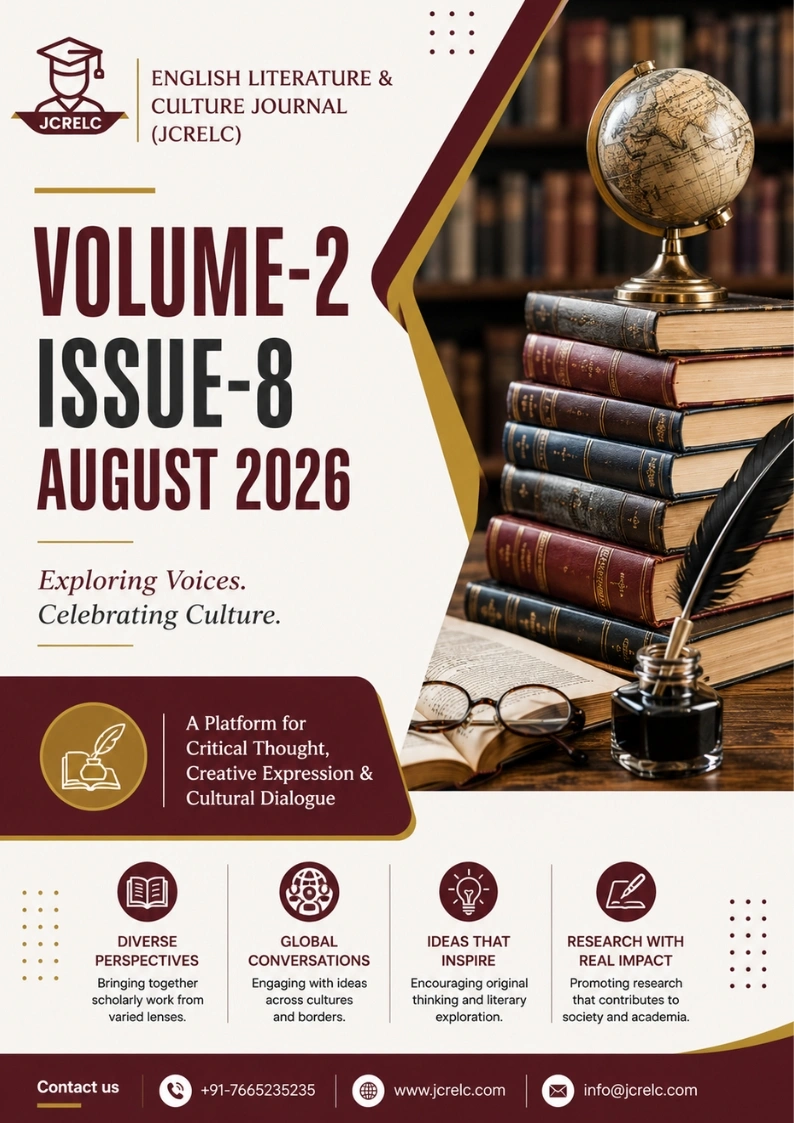
Volume-2, Issue-8, August 2026